



Native SuiteApp vs iPaaS for NetSuite
Two ways to integrate NetSuite, one big architectural difference: does the integration run inside NetSuite, or in a separate cloud between your systems?
Jump to a section6 sections
What you'll learn
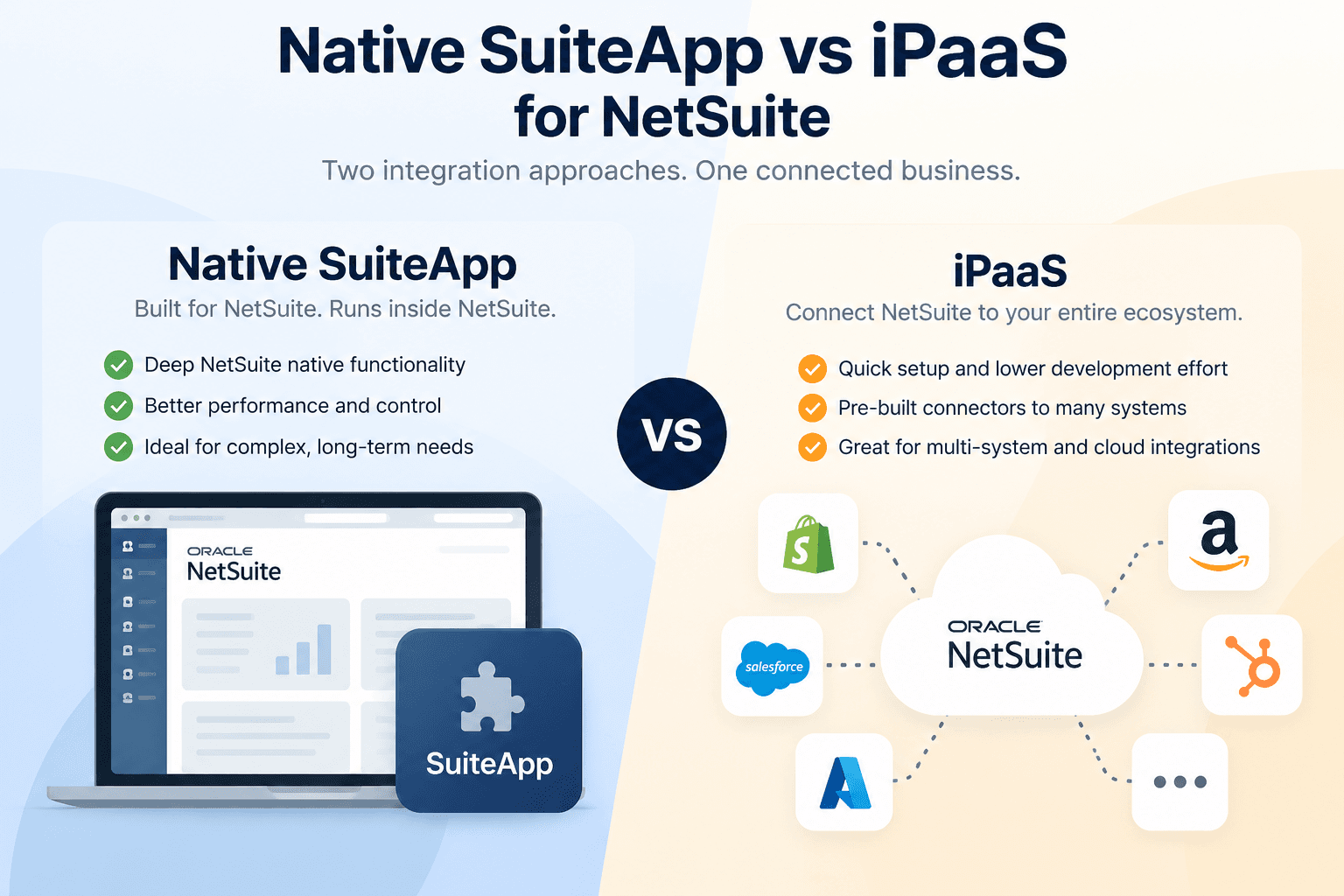
- A native SuiteApp executes inside NetSuite; an iPaaS runs in its own cloud between systems.
- With a SuiteApp your data never leaves NetSuite; with an iPaaS it passes through a third-party platform.
- SuiteApps are typically priced per integration; iPaaS platforms use tiered or usage-based subscriptions.
- Pick a SuiteApp for NetSuite-centric ops; pick iPaaS for many-system orchestration beyond NetSuite.
What is a native SuiteApp?
A SuiteApp is an application built on NetSuite’s SuiteCloud platform that installs into your NetSuite account. A native integration SuiteApp runs the sync logic inside NetSuite, so there is no separate system between NetSuite and the connected platform. Records move directly, and the data stays within your NetSuite environment.
What is an iPaaS?
An integration platform as a service (iPaaS) is a cloud product — Celigo, Boomi, Workato, and others — that connects applications by moving data through flows you build and run on their platform. NetSuite becomes one endpoint among many. The strength is breadth: an iPaaS can orchestrate dozens of systems. The trade-off is that it is another platform to host, learn, pay for, and maintain, and your data transits a third party.
The key differences
The architecture drives everything else — where data lives, how it is priced, and who keeps it running.
- Where it runs: SuiteApp = inside NetSuite; iPaaS = external cloud.
- Data residency: SuiteApp = stays in NetSuite; iPaaS = passes through the platform.
- Pricing: SuiteApp = per integration; iPaaS = tiered / usage-based subscription.
- Maintenance: SuiteApp = no middleware to run; iPaaS = a platform your team owns.
- Best at: SuiteApp = NetSuite-centric sync; iPaaS = many-system orchestration.
Which should you choose?
If NetSuite is the hub of your operations and you want the fewest moving parts, a native SuiteApp such as In8Sync DirectConnect keeps the integration inside NetSuite with no middleware and predictable cost. If you are stitching together many systems where NetSuite is just one node, an iPaaS may justify the extra layer. See our head-to-head "In8Sync vs Celigo" for a concrete example.
Frequently asked questions
Is a SuiteApp always better than an iPaaS?
No — it depends on scope. For NetSuite-centric integrations, a native SuiteApp removes a whole layer and keeps data in NetSuite. For orchestrating many non-NetSuite systems, an iPaaS’s breadth can be worth the added platform.
Does a native SuiteApp keep my data in NetSuite?
Yes. Because the integration runs inside your NetSuite account, records sync without being routed through an external integration cloud.
Is In8Sync a SuiteApp or an iPaaS?
In8Sync DirectConnect is a native SuiteApp. It installs inside NetSuite and syncs in real time with no middleware and no per-record usage fees.